

Set Pieces Win Titles
📊 EFL Trends | Sam Parry explores how three champions, three different styles and one shared advantage reveal football’s most controllable edge.
Written by Sam Parry
1. Are we talking more about set pieces for a reason?
“The ball is round, the game lasts ninety minutes, and everything else is just theory.”
—Sepp Herberger
Theoretical considerations have always interested me. Logical reasoning too, which is why I was grateful to Opta Analyst for furnishing one suspicion with evidence: football in 25/26, if not the game itself, is played for considerably less than ninety minutes.
You need only watch the miraculously recovered goalkeeper getting to his feet and two sets of eleven players returning to their pitch from the touchline to recognise that time in football is never dead space and nearly always tactical.
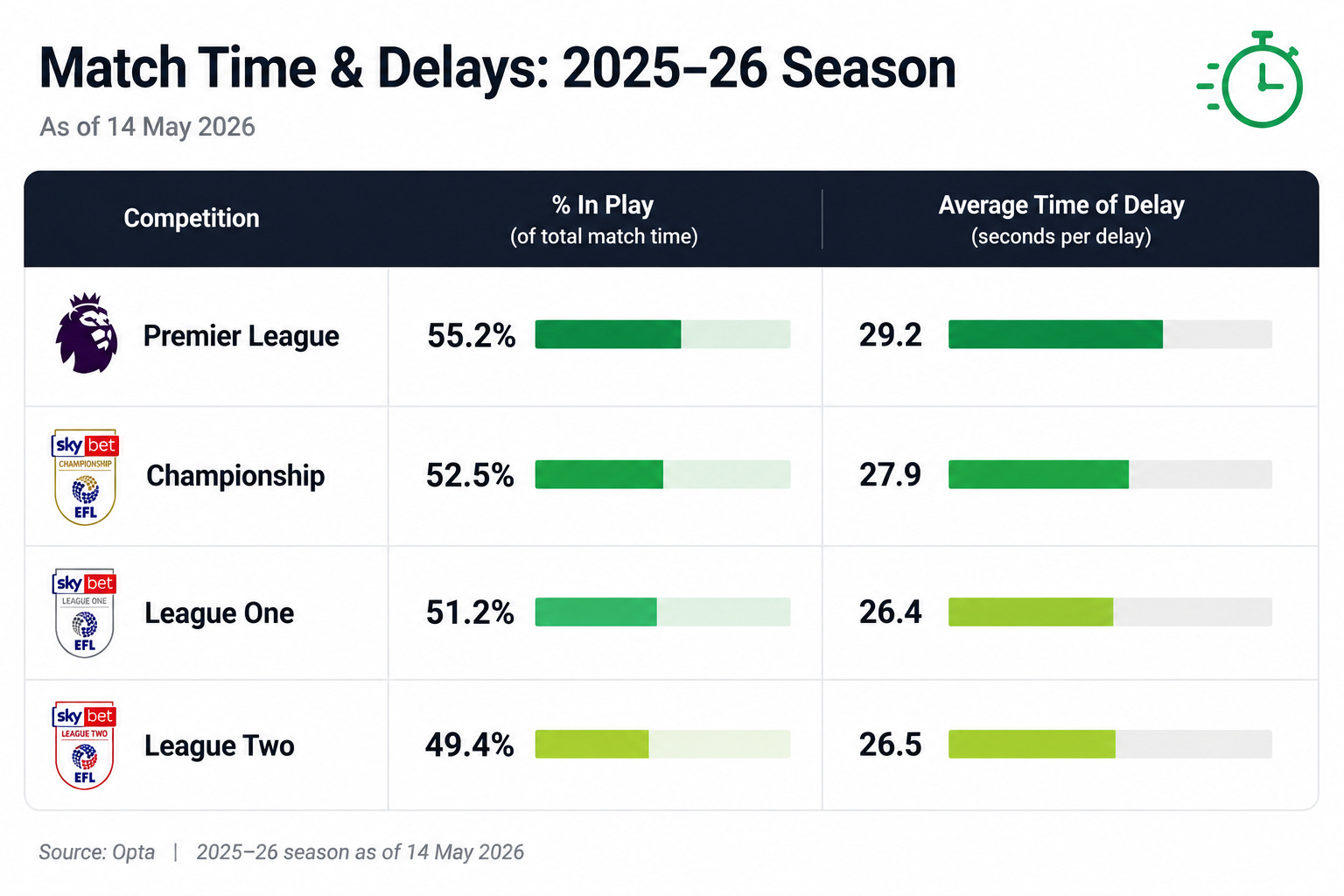
In League Two, delays last longer than the ball is on the pitch. Goals. Goal kicks. Throw-ins. Corners. Free kicks. Injuries. A whole heap of miscellaneous interruptions besides; they all add up. And the best delays lead to goals.
Remember set pieces?
Sourdough predates sliced bread by centuries, and that hasn’t stopped an increasing number of people rediscovering the pleasures of airborne yeast. Not dissimilarly, set pieces have become a rising point of discussion, and like all good hipsters, we were talking about them before they were cool.
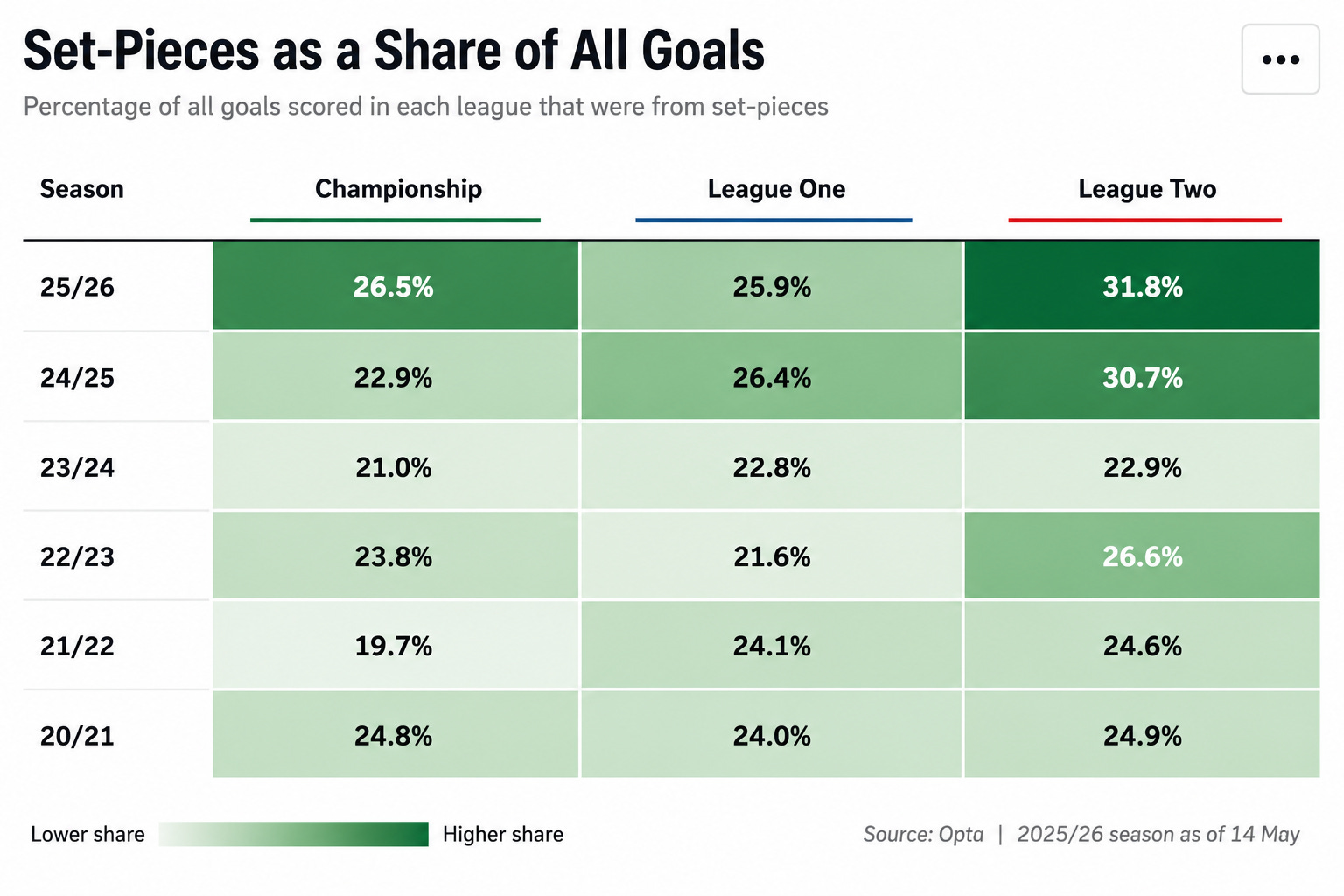
Two years ago, Ali Maxwell described set pieces through the lens of Snakes and Ladders: “Having set-piece quality is like landing on a ladder.” He was right about that. And clearly EFL clubs have sought out the ladders; in each league, set pieces have trended upwards, accounting for a greater proportion of goals year-on-year since 20/21.
All EFL set-piece goals from 2020/21 to 2025/26
Percentage figures show the proportion of total goals scored from set pieces
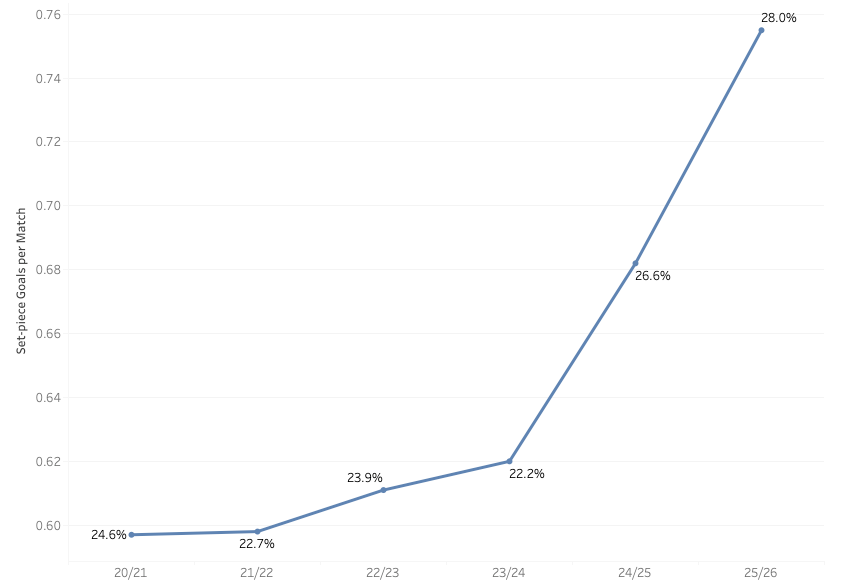
Ali’s board game analogy wasn’t suggesting teams rely on a dice roll but instead that dead-ball situations can provide decisive advantages in tight games. Most games are tight. And within them, set-pieces provide the most direct route to goal during the most static moment of play, making them capable of creating an edge.
In the time since that article was published, the edge has become sharper, and the harsh upward slope of the graph above reminds me of a quote by Charlie Munger, Warren Buffett’s long-time deputy, who said: “Show me the incentive and I’ll show you the outcome.” Football works neatly in reverse. Show me a league title, and I’ll show you the incentive.
2. Do set pieces win titles?
In the EFL, where financial gaps can be significant and squad quality varies, small margins on a game-by-game level can decide promotions and relegations. The graph below plots the top seven teams in each EFL division against the number of set-piece goals they scored.
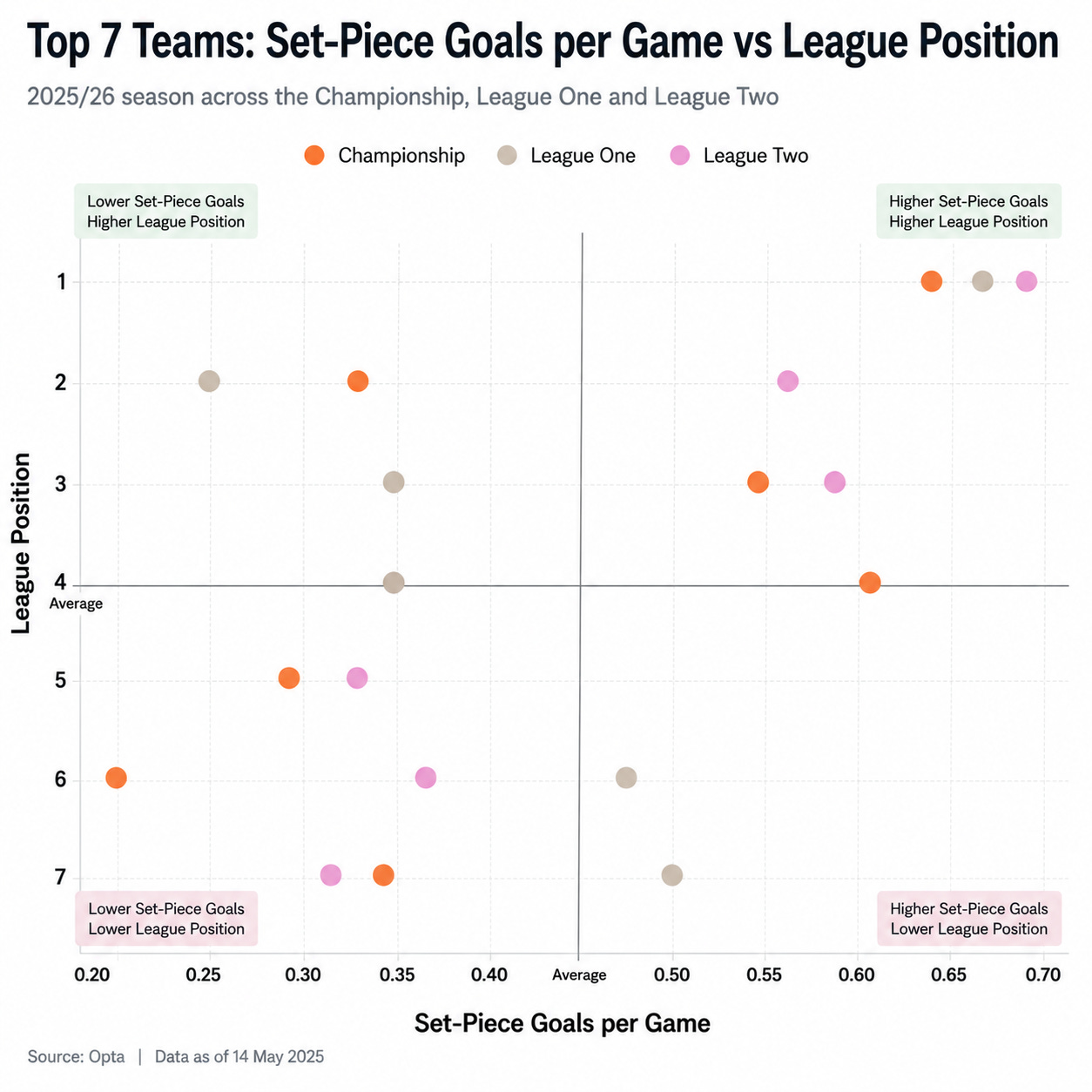
In the top right sit three neatly aligned spheres: orange, grey and pink planets lining up behind Coventry, Lincoln and Bromley. Three champions. Three teams that topped their division for set-piece goals. Three tallies, which when added up, give each a share of 90 set piece goals.
Correlation is not causation, and the dead ball is not magic. Coventry, Lincoln and Bromley won their divisions based on many factors I won’t discuss in detail: all of them scored a greater share of non-set piece goals, whether from open play, direct free kicks or the penalty spot, and that’s before mentioning the defensive work to stop the opposition in the same situations.
Still, when each EFL title winner scored 30% or more of their goals from set plays, it’s worth asking how and why, especially when you consider none of the champions are newly promoted or relegated sides, and none were amongst the top 3 highest spenders in their respective league.
Throw-ins and corners haven’t suddenly become football’s cheat code. But because set pieces are more controllable than open play, more rehearsable, more repeatable, more coachable, and compared with signing a pricy striker, relatively cheap, it stands to reason that they are an attainable advantage available to all teams.
Whatever the ambition of a football club, being good in both boxes from dead-ball situations is a huge incentive. Sometimes the gains are incremental. Sometimes, as in 25/26, they are transformational.
3. League Two | Bromley
Do “set-piece teams” actually exist?
Every team is different. Styles create attacking pressure in different ways. Some teams build territory patiently. Some cross early and often. Some move the ball forward quickly. Some press high and turn possession into chaos. Some do a hybrid.
But is there actually a recognisable set-piece identity? Do certain styles naturally create more dead-ball chances? And does that change from league to league?
League Two feels like the natural place to start. If the EFL has a stock image for a “set-piece side”, it probably lives here (and it is probably Bromley).
But first, here is the division through a set-piece lens.
Top Lines
Cambridge and Barnet posted elite +16/+17 SP GD
Bromley generated 31 SP goals, the highest among these sides
Crewe were the biggest outlier: +10 over xGD
Shrewsbury scored a whopping 52% of their goals from set pieces
Relegated Harrogate scored the fewest set-piece goals in the EFL
The stereotype writes itself. Good set-piece teams are supposed to be physical, direct and permanently one throw-in away from marching both centre-halves into the opposition box.
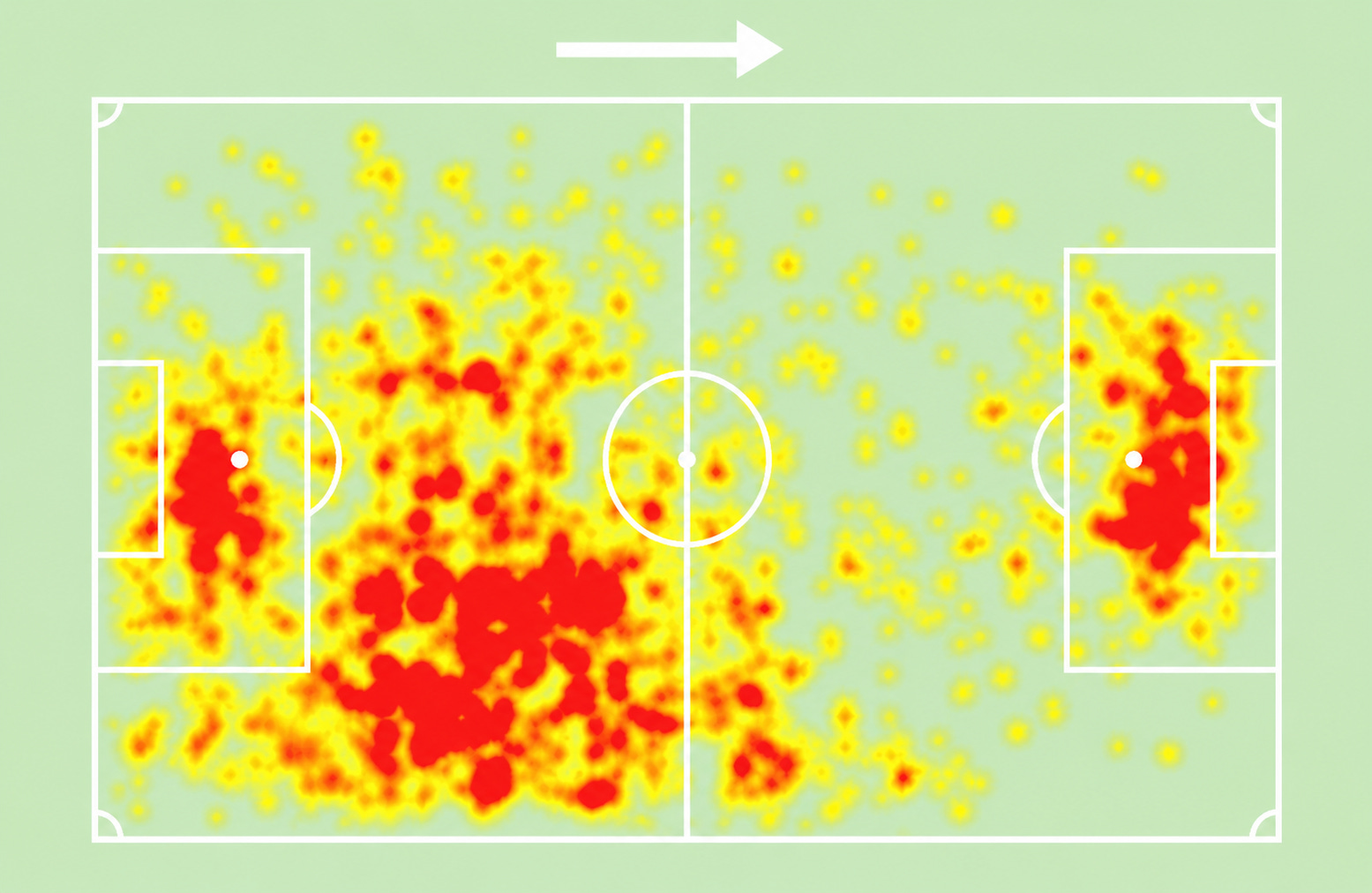
Bromley fit that image rather neatly. Much of their attacking output came through Mitch Pinnock, who recorded more accurate crosses per 90 than any League Two player this season (per FotMob). The same Pinnock who takes corners and free kicks. The same one who takes long throws. The guy who never actually gets himself in the box but is responsible for getting it in there. It’s almost like they recruited smartly.
Mitch Pinnock (LM/LW) Heat Map (SofaScore)
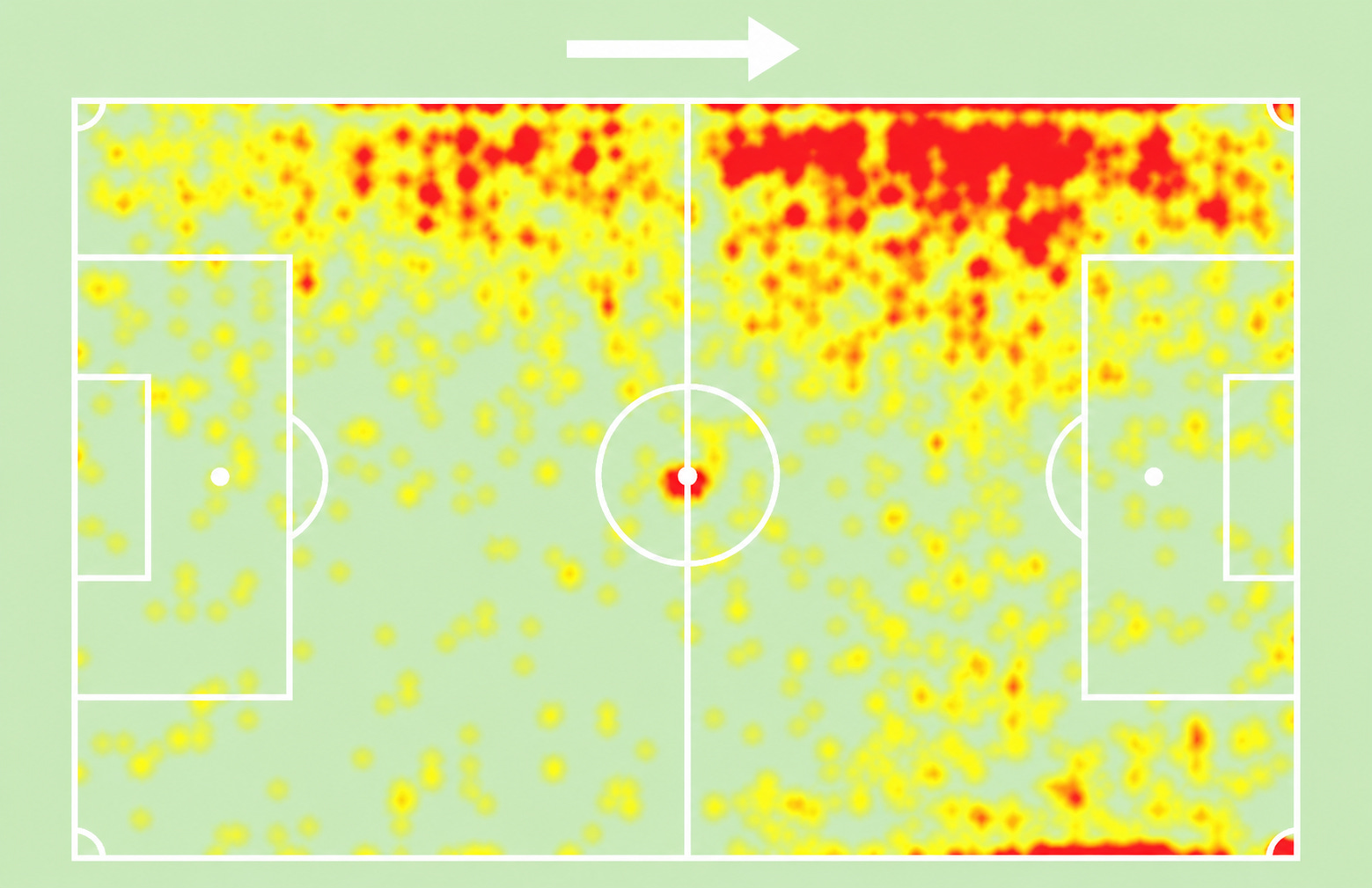
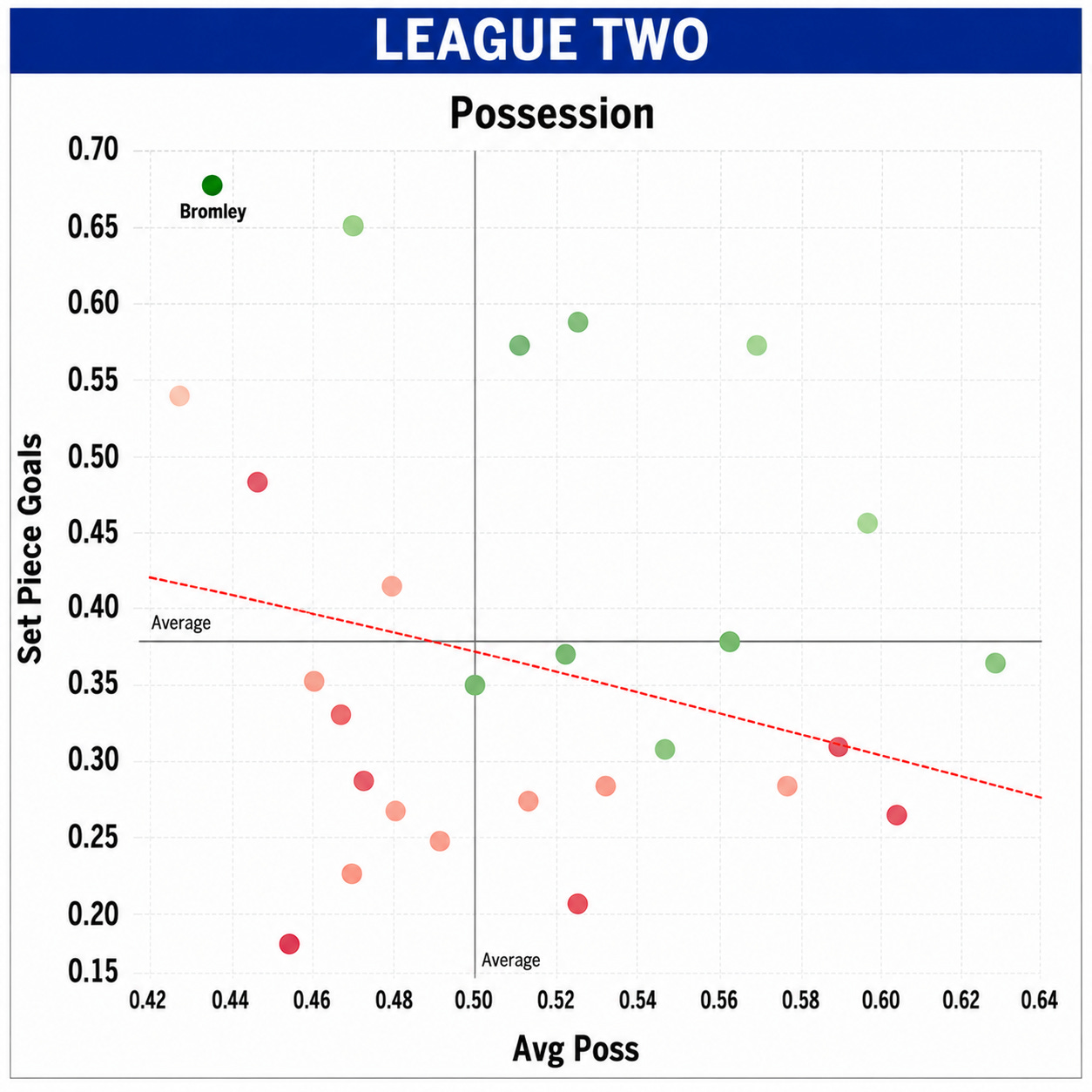
Does that cross-heaviness have a bearing on set-piece output? For Bromley it seems to; they get in those areas through wing play.
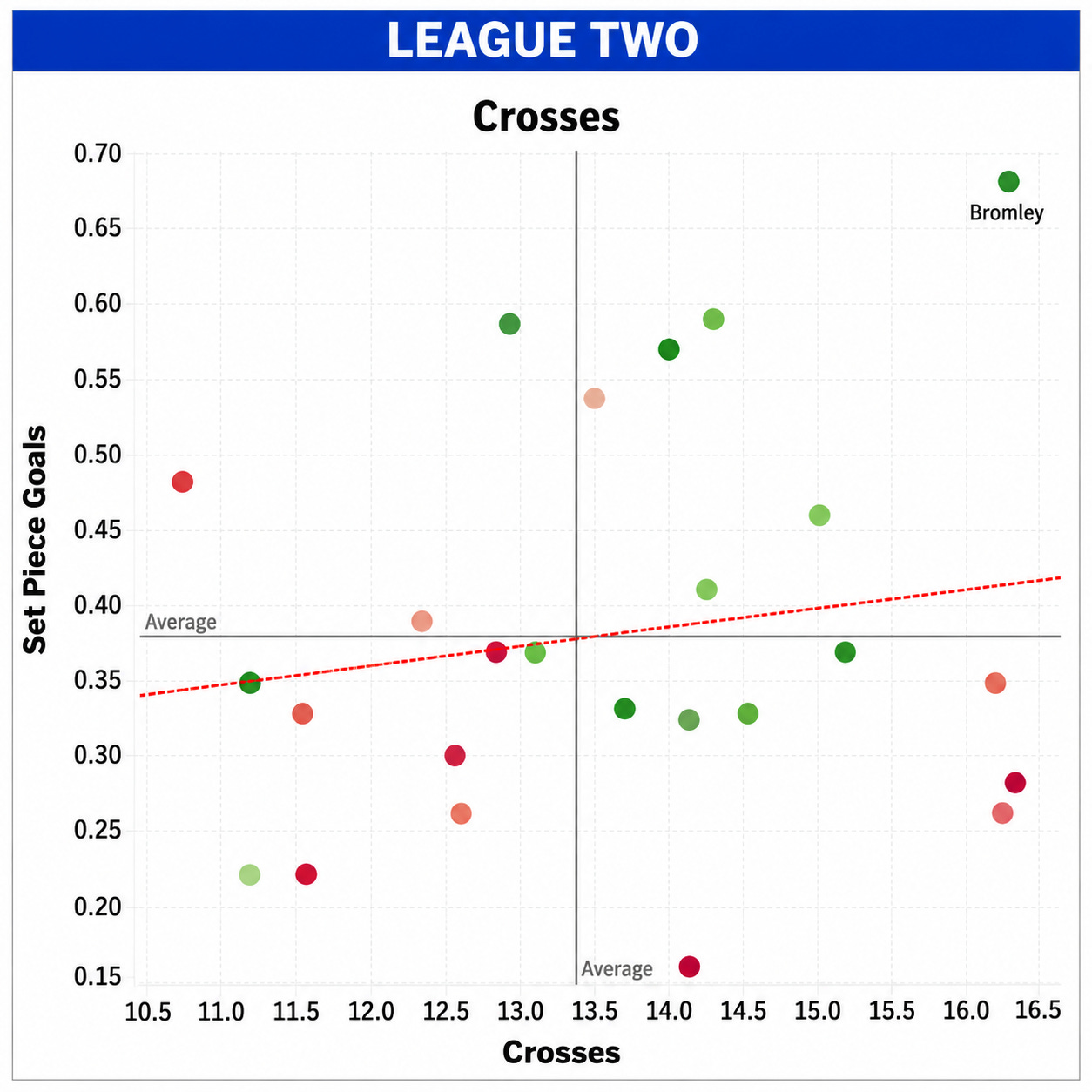
Overall, there is a relationship here, but a fairly baggy one. Cross-heavy League Two teams do tend to score more set-piece goals, though the trend is far from overwhelming. More interesting is the shape of the league itself. League Two appears to carry a broader preference for crossing and early delivery.
That does match the eye test. Lower down the pyramid, football often becomes a little less about patient possession and a little more about getting the ball forward and asking questions later.
The relationship becomes slightly stronger when we move from crossing toward direct speed: a measure of how quickly teams progress the ball towards goal. Or, in less technical terms, the “gerrit forward” metric.
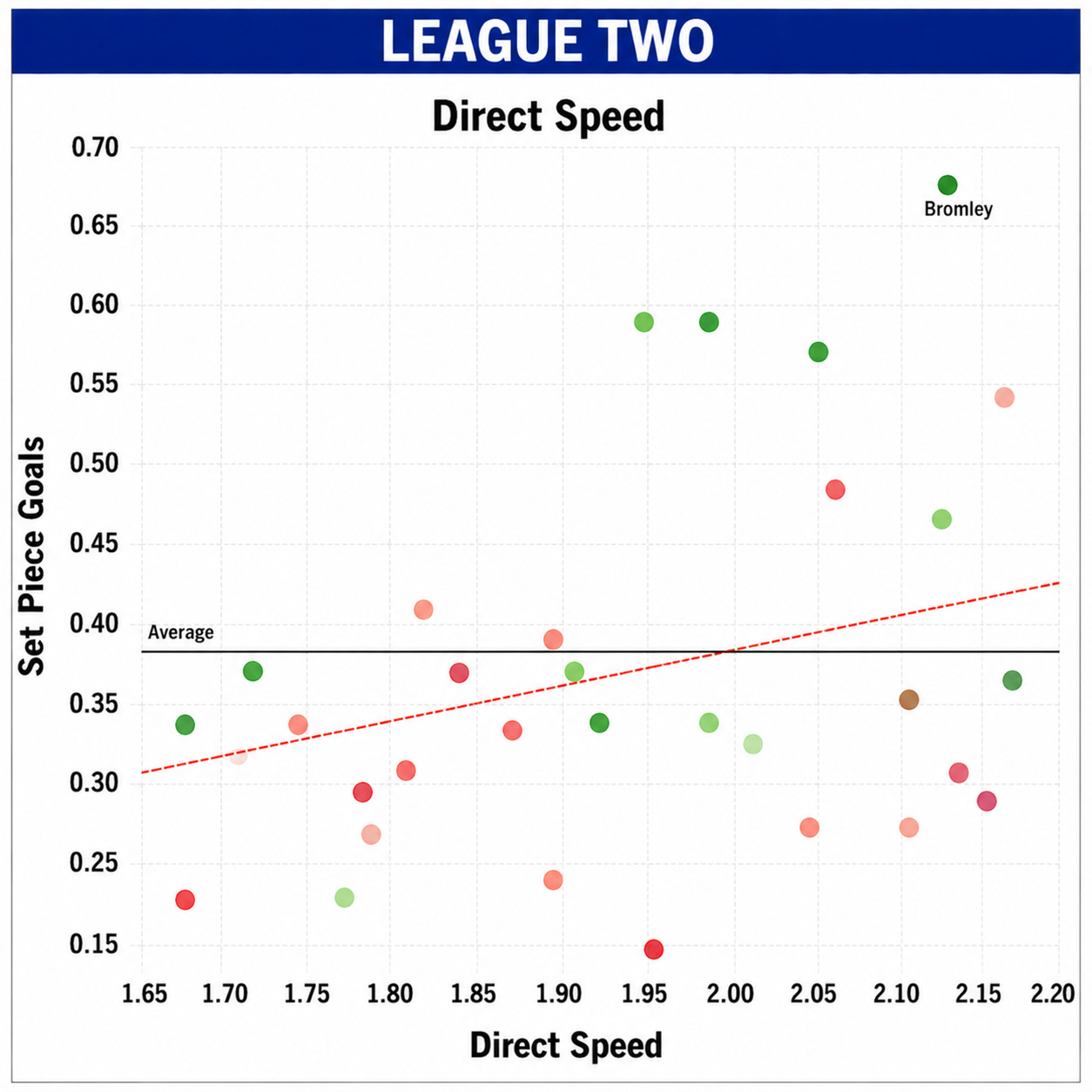
From crossing to direct speed, and also (below) possession, teams broadly trend toward or away from the Bromley model. Andy Woodman’s side were simultaneously the outlier and the archetype: move the ball forward quickly, find a wide player, wang it into the box and generate dead-ball pressure from the resulting chaos.
If Mitch Pinnock’s heatmap reflected a partial image, Omar Sowumni’s completes the picture. Perhaps nothing captures Bromley better: active in both boxes, but if anything, more heavily involved in the opposition’s.
#2 Omar Sowunmi (CB) heat map (SofaScore)
That is where they diverge from our other two champions; Bromley conceded the 7th-most set-piece goals in League Two. Their edge was all about attacking set pieces. Their success points toward a familiar conclusion: direct teams, crossing teams and transition-heavy sides appear more likely to generate set-piece value.
Which sounds rather neat. Much too neat. Because all of this still leaves one assumption untouched: Does creating more set-piece opportunities actually guarantee more success?
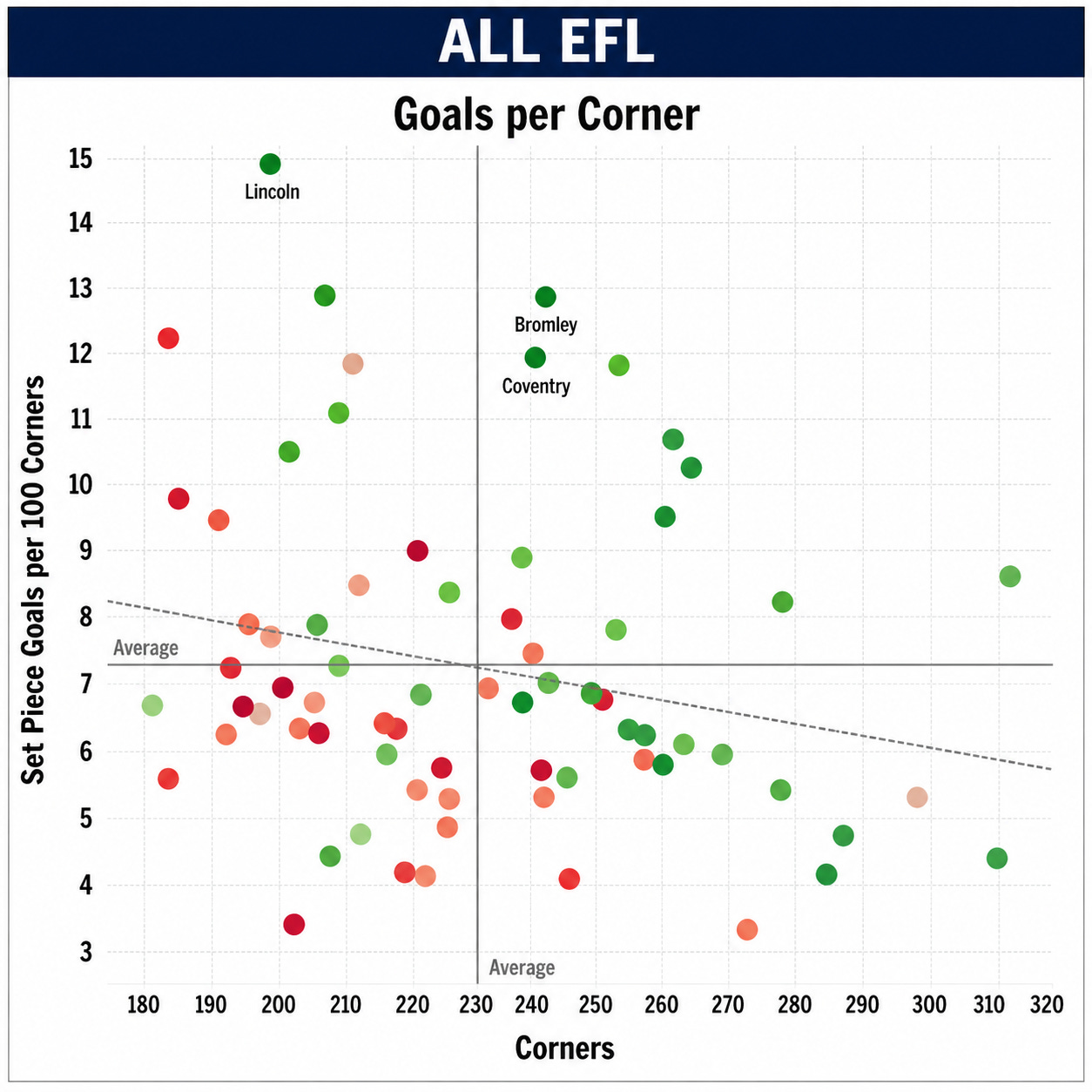
The answer is no. What matters more than anything is execution.
4. League One | Lincoln
What is a set piece anyway?
While Bromley looked like football’s stock image of a set-piece side, League One starts to ask slightly different questions.
The strongest teams here succeeded in very different ways. Lincoln generated elite dead-ball output. Cardiff finished second despite producing relatively little of it. The profile feels messier. Less obvious.
Let’s start with the third-tier round-up.
Top Lines
Lincoln and Plymouth are tied 1st for SP goal difference with +17
Stevenage scored 43% of goals from set pieces
Luton massively outperformed process (+10)
Leyton Orient have the worst set piece GD in the EFL
Lincoln stand out immediately. Last August, Chief Executive Liam Scully explained the club’s thinking to Sky:
“Our aim is to find the biggest points of difference. It is knowing where we can shift the dial, make the biggest impact, get the biggest bang for our buck. Set-pieces, for example? We set out to be the best in the division at it. We managed to be the best in the country.”
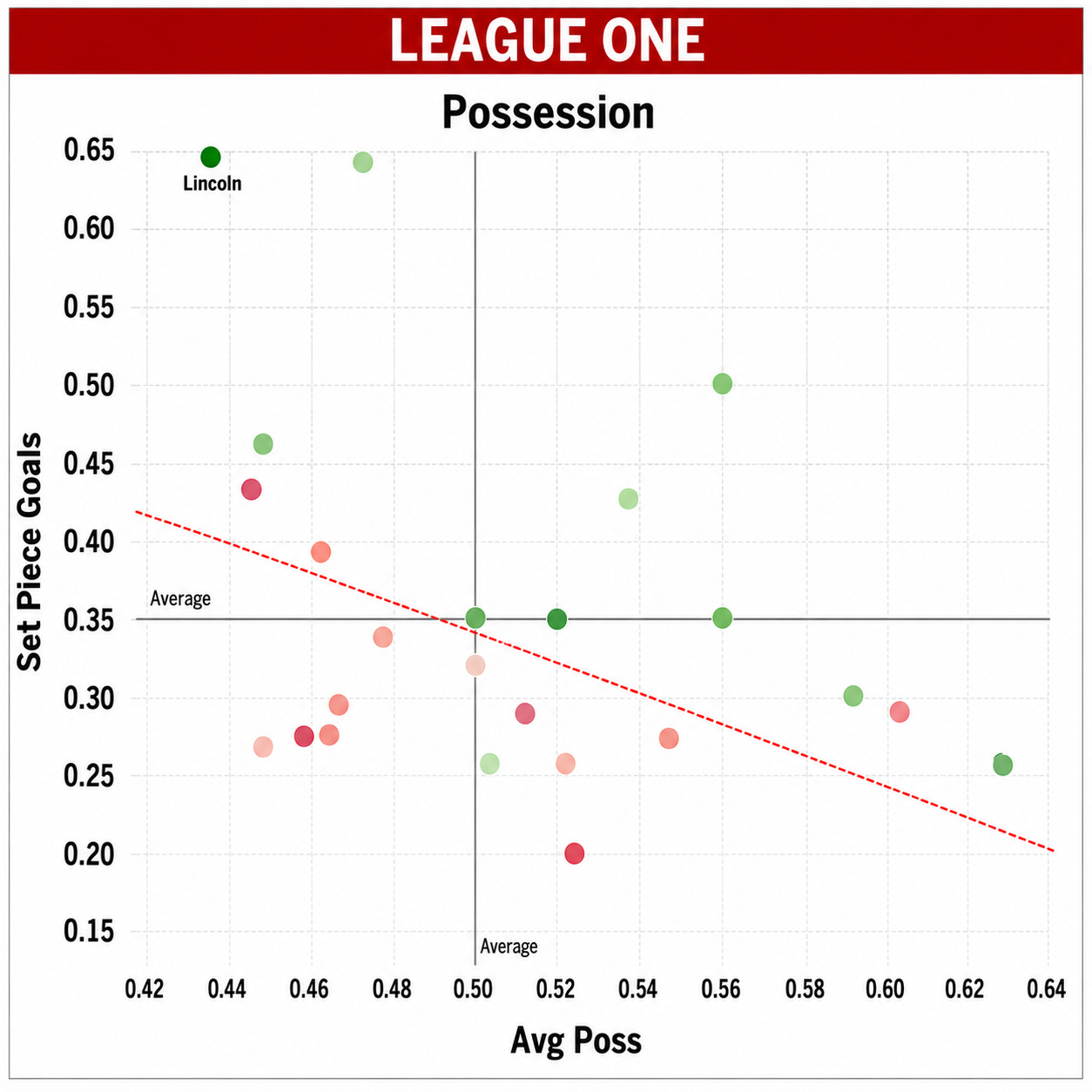
They had delivered on that ambition in 24/25 with set-piece coach Scott Fry moving to Rangers in November off the back of their success. His departure didn’t stop them from continuing that success in 25/26 where, like Bromley, the rest of the league tends to trend away from or towards their success profile: less possession, fewer crosses, more direct speed.
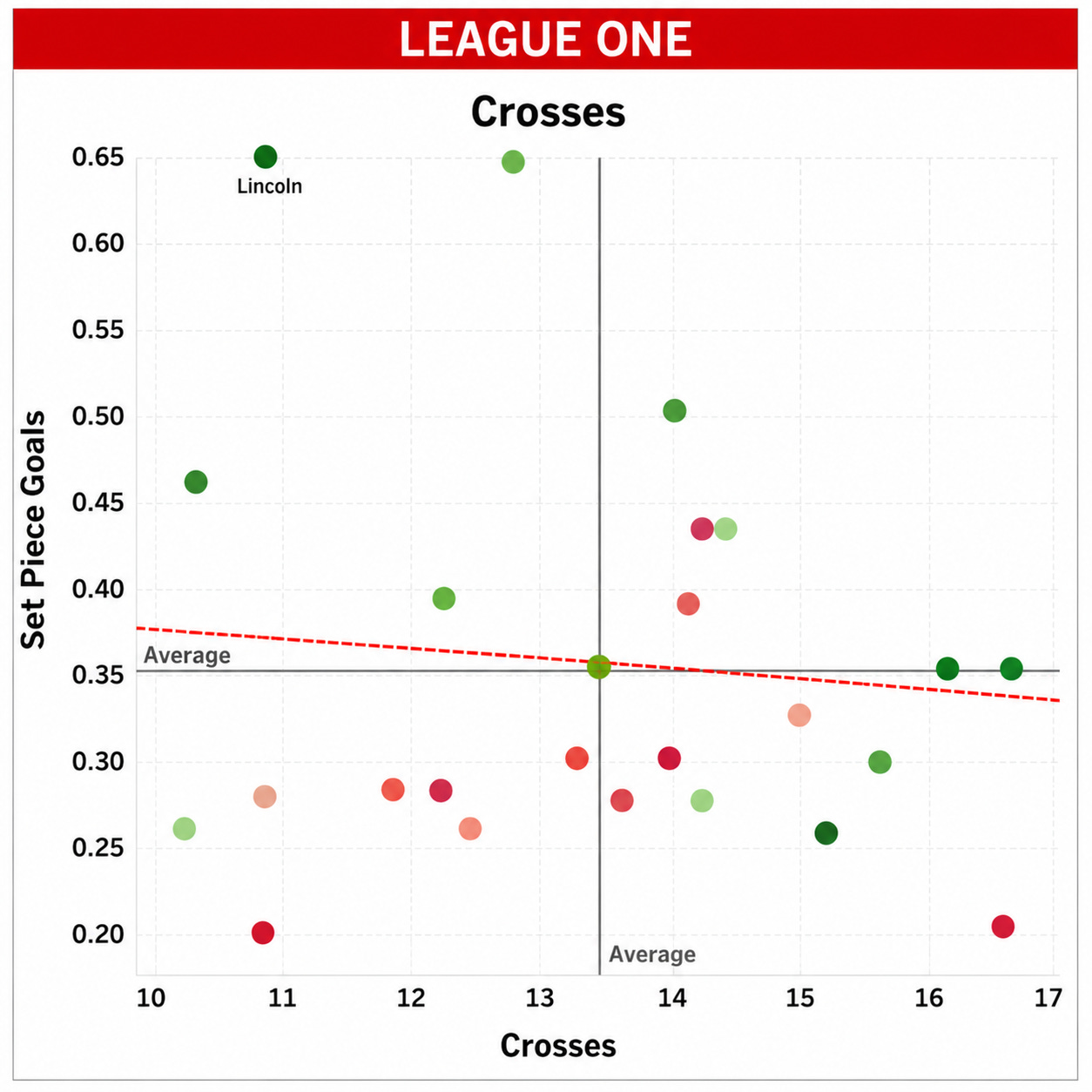
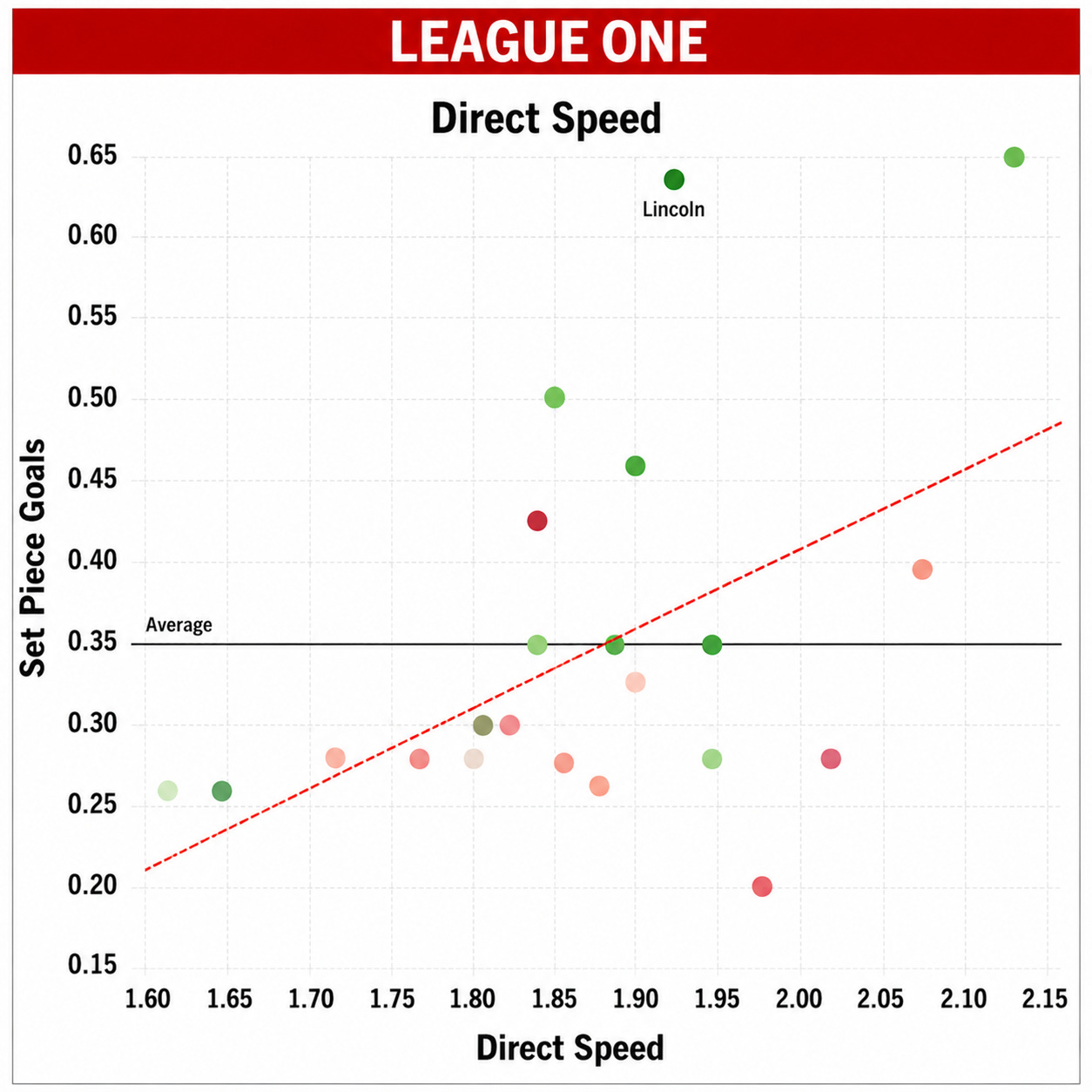
With familiar ingredients, Lincoln are slightly different. Per FotMob, 10 of Lincoln’s 30 set-piece goals came from throw-ins this season, aided by Tom Hamer and one of football’s rarest pleasures: a long throw with actual end product.
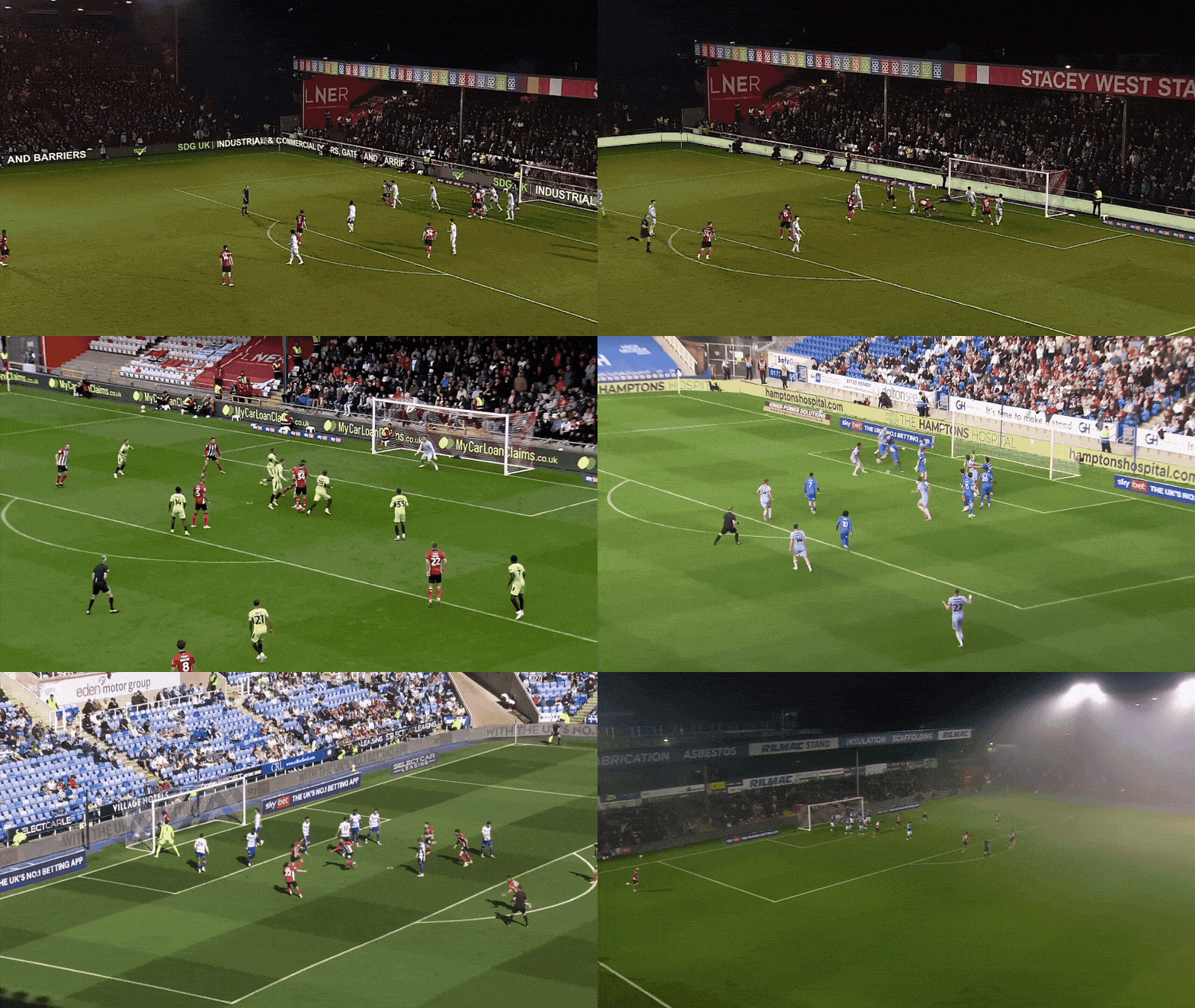
With height, delivery and targets in the box, Lincoln appear to confirm with a classic set-piece recipe. Which is why what comes next feels slightly strange. Because Lincoln’s 30 set piece goals may not actually be what they seem.
What counts as a set piece goal?
Opta define set-piece goals as those beginning from a dead-ball situation — corners, free kicks, or throw-ins — that result in a shot before the phase of play has broken down into open play. In the liminal space between set-piece and open-play is where Lincoln excel.
In the second phase, clearances become loose balls. Recycled crosses create chaos. Pressure is sustained, but differently. And this creates an entirely new defensive problem. When the first ball is delivered, defending is relatively ordered. Players know their assignments. Markers are matched to runners or zones. Space has been rehearsed. Movements have been studied on the training ground.
But once the ball breaks loose, structure begins to dissolve. Defenders are caught between stepping out and holding their line; between closing down a crosser and protecting the space behind them. The rehearsed becomes situational and, dare I say it, transitional.
Gary Neville once described holidays as “mini-retirements”. The second phase of set pieces feels more like a mini-transition. The first phase is organised; the second is reactive. Players are no longer anticipating rehearsed movements but responding to uncertainty. Today, the best set-piece teams may not simply dominate the first ball. They are more likely to dominate what comes next.
Lincoln have, according to our research, scored from 10 second-phase goals — the most in League One.
