

How Eric Ramsay wrote Ryan Mason's West Brom obituary - and then his own
Sam Parry on why the logic of sacking managers continues to be so brutally dumb.
Sam Parry
“It’s undeniable that the squad is capable of more than where it is at the moment.”
Those were the words of Eric Ramsay in his first interview as West Bromwich Albion manager. Were they true then? Are they true now?
With West Brom looking for a new manager, one name is not doing the rounds: Ryan Mason. There are logical reasons for that, of course. Who rehires a manager they just sacked? (OK, Sheffield United, but who else?) It doesn’t happen. And maybe the sacking shouldn’t have happened in the first place. At the very least, the club might furnish Baggies fans with some indication as to why they deemed Mason more unsuited to the job than, say, Eric Ramsay.
You cannot claim unfair dismissal when your higher-ups sack you for a subjective judgement on your performance. But if you could, would Mason be in with a shout? Plenty of West Brom fans would say no. A fair few might say yes. Either way, Mason’s successor demonstrated a Nostradamic aptitude for predicting a double downfall.
Before he was ever linked to the top job at The Hawthorns, and more than a year before he took it, Eric Ramsay spoke of his contentment with life as manager of Minnesota United.
“The length of a tenure here [MLS] is significantly longer on average than it is in the Championship.”
“You’ve got really sensible people that are looking at the long-term vision of the club. I felt like this was as good a chance as I was going to have to make sure that when I come out the other side of this, I’m as well prepared for whatever comes next as I could be.”
In May 2025, after Tony Mowbray’s departure, Ramsay was installed as favourite for the West Brom job. The role was instead given to Ryan Mason, whose 26-match spell in the Championship ended on 6th January. He delivered 31 points, with a solid home record undermined by a poor away run, including 11 losses.
At the time, I wrote about how West Brom had dispensed with Mason’s services while they had the division’s third-best xG ratio over his final five games, and the fourth-best over his final ten. The sackable offence, presumably, was that his team had taken only 9 points from those 10 games. We can also only assume that performance data was either ignored or overlooked as a mitigating factor when the club weighed up whether or not to sack the 34-year-old.
As supporters, we are ignorant of the conversations that take place behind closed doors, although it is fair to assume they do take place. You would love to be a fly on the wall when Chris Wilder or Will Still got the boot on the back of strong underlying performance data – and, in the former’s case, a brilliant points return. Arguably it was similar for Ryan Mason, for Lee Grant at Huddersfield, and even for Darren Moore at Port Vale, bottom of League One. All three clubs, per Not The Top Table, are showing poorer underlying numbers under their new bosses. But that is to overanalyse the outcome.
We all know sackings are common. Many have a curative effect on a team’s form; many more fail to be any such tonic. The biggest reason for their prevalence is that, to a club’s owner(s), sacking a manager is the only lever available when they believe the team is underperforming expectations. The issue with that, as George Elek pointed out, is that in a 24-team division, one team has to finish 24th, 23rd, 22nd and so on. And yet nobody seems to expect, and certainly will not tolerate, the realistic possibility that their season will be something other than rosy.
What are and what were West Bromwich Albion’s expectations? Obviously, to the board, 18th place after 26 games was below the standard. But was it right that Mason was made to carry the can in January?
I’m sure there are West Brom fans who would argue the sacking was fair. But, with the January transfer window in its infancy, it isn’t difficult to argue that the best person to fix personnel issues within the squad was the man who had spent the first half of the season learning its flaws. In firing Mason, they lost his instinct for what needed to change. Whether those instincts were good or bad, they were uniquely formed by the singular experience of… you know… actually being West Brom’s manager.
Instead, Mason’s career – like so many before and so many to come – was defined by a bad run of form. It was decided, above his station, that he had failed to such an extent that another individual was more likely to improve the situation.
This is a logical fallacy.
With so much money sloshing about in football, it amazes me that such muddled thinking persists. But the formula is simple: one part outcome bias, one part recency bias, and a few parts attribution error. How often do we see an individual, the manager, blamed for situational factors such as injuries, squad quality, an out-of-form striker or a couple of individual errors? Or, as with Mason’s final game, a 2-1 away defeat when Abdul Fatawu volleys home a sensational winner in the 94th minute after WBA have created three big chances, had eight shots on target and hit the post?
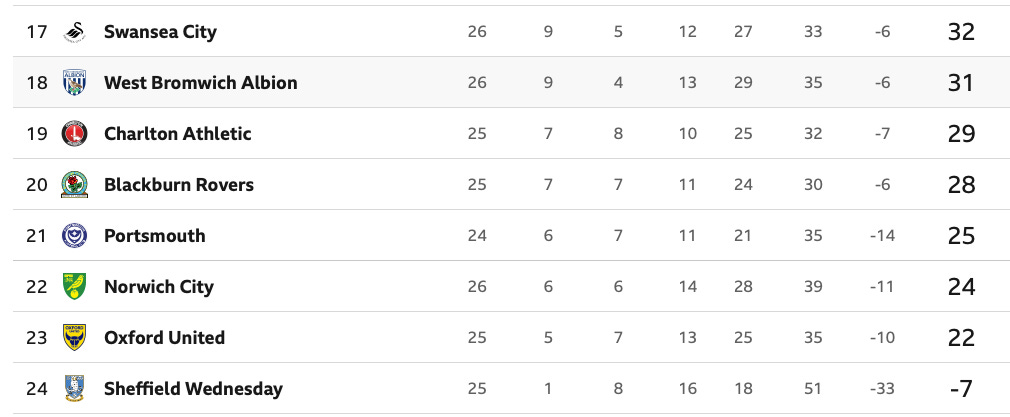
When Eric Ramsay joined the Baggies on 11 January, he was the beneficiary of an illogical churn that he had already articulated with clarity:
“As a young British coach, you can get lots of hype around [you] very quickly and end up moving through the steps very quickly, but then the career can be over before it has begun.”
During his first interview in post, Ramsay also spoke to the questionable logic behind sacking Mason in the first place. With hindsight, the comment feels even more pointed.
“Everyone who has watched a good chunk of this season will recognise there has been an element of misfortune.”
Fortune and misfortune are underrepresented in discussions of the hire-and-fire approach in football. These situational factors and considerations are rarely enough to save a manager during a poor run of form. Citing mistakes and poor decision-making is far easier for owners, board members, fans and, well, me.
Ramsay made one of his own in his very first game.
Wedded to a particular shape, he deployed Mikey Johnston, arguably West Brom’s best player, as a right-sided wing-back during his opening defeat to Middlesbrough. Watching that match, it felt utterly bizarre. The decision heightened Johnston’s weaknesses and masked his strengths. It was difficult to see how this could possibly be the bold answer to West Brom’s woes – and it wouldn’t have been the case had Mason been in charge.
Dig a little deeper and the situation looks even stranger. Across Ramsay’s eight Championship matches in charge, Johnston started at right wing-back, left midfield, right midfield, in a floating central attacking role and once on the left wing, along with three appearances from the bench. Notably, he didn’t provided a single goal nor assist under Ramsay, despite continuing to top the squad’s rankings for goal contributions (11).
This is just one tightly focused example of Ramsay struggling to correct a problem of his own making. That isn’t to say Mason had everything solved. Rather, it highlights how changing a manager can overcomplicate and distort issues that didn’t necessarily require such upheaval.
Still, it wasn’t Ramsay’s difficulty in finding Johnston’s best role, or his hesitancy between sticking and adapting, or even adopting a style of play that looked ill-suited to the squad, that ultimately defined his spell. All of that would likely have been forgiven if West Brom had simply won a few games. Winning is the handmaiden of patience, after all, and losing is the chaperone of its opposite.
They did not win a few games. They did not win any games.
Thanks to a record of P8 W0 D4 L4 under Ramsay, West Bromwich Albion now sit just a point above the relegation zone. They’d be in it were it not for Leicester’s points deduction.
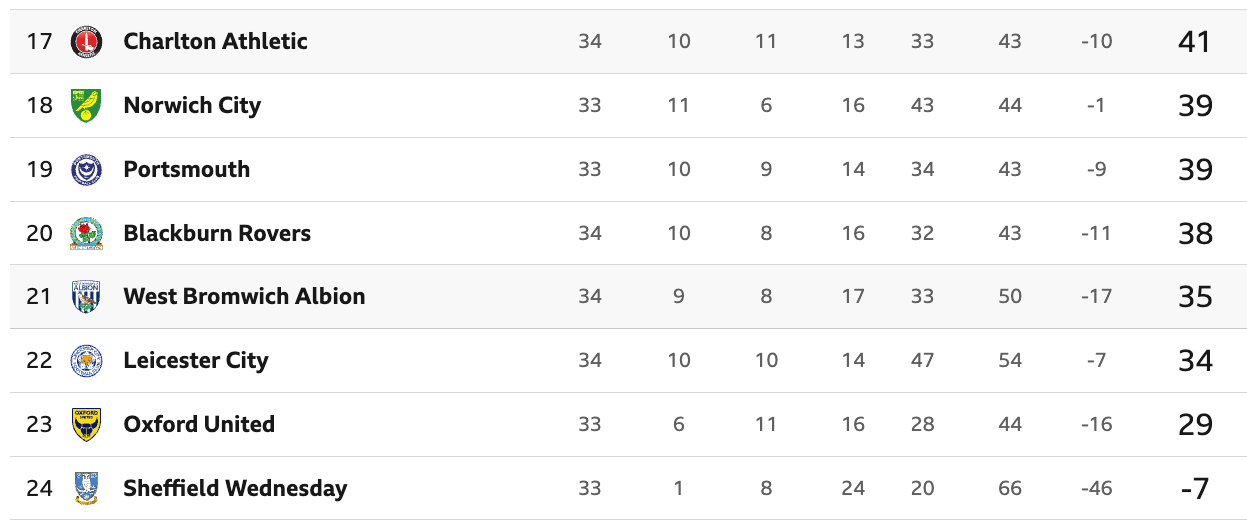
None of this is intended as a critique of Ramsay’s coaching ability, nor a defence of Mason’s. It is fascinating, though, that someone who so clearly understood the precarious nature of taking a job in England arrived in the Midlands and told supporters: “It’s undeniable that the squad is capable of more than where it is at the moment.”
All right, so it reads more like a truism now. But was it true when Ramsay took over? Was it true when Ryan Mason’s final seven games – two wins and five defeats – were all decided by a single goal? You may answer yes to all those questions and you may be right or wrong and it still won’t matter because, ultimately, they are the wrong questions. The right question is one of decision-making.
This is the thing I cannot fathom.
Strip away the individuals involved and focus on the logic of those behind the scenes. Why was there so little faith in one man and so much faith in the other? In this example, and so many more, there is no good answer. The buck stops short of those who really make decisions. Personally, I think that stinks.
It stinks that managers are the only accountable figureheads at football clubs. It stinks that too many owners can’t practise a scintilla of patience. And it stinks that what is missing on the managerial obituaries of Ramsay and Mason alike is an adequate account of why they were hired in the first place and fired in the second. Luckily, Eric Ramsay, a man who walked into the trap he predicted, wrote it already:
“Getting managers sacked is a bit of a national sport.”
Interesting article. Worth comparing what happened with Chris Davies at Birmingham. Very similar style of team to WBA under Mason, decent xG performance, also struggled away from home. The manager was under pressure. But he was backed instead of sacked, iterated his style of play and we are now one of the form teams in the league. Sometimes the 'do nothing ' option is the right one.
I think the fanbase has played a big part in the lack of patience that has been outlined at board level:
1. Masons confidence started to crumble when the midweek fixtures started to hit. The team changes and last minute goals eroded confidence on the pitch and in the stands, and the 2 goals conceded against Swansea on 29/11 created a big fracture between club and supporters. That led to Wildsmith being brought in to protect Griffiths, Mason and his relationship didnt recover and his position did feel untenable.
2. The pressure was on Ramsey right from the off in game 1 against Boro. 'what the hell is this' was the general reaction to his low block approach. In short he stepped into the toxicy surrounding Mason and never got going.
I do think our inexperienced board have buckled like our inexperienced managers, but it does have alot to do with the civil war that has been experienced everywhere from board level, manager and player relationships, potentially player to player relationships and the fans Vs anything with a pulse. A proper Royal Rumble of a season desperately needs to be rectified now!